

Student Name
Capella University
NURS-FPX4025 Research and Evidence-Based Decision Making
Professor’s Name
Submission Date
Analyzing a Research Paper
|
Criteria |
Analysis |
|
Type of Study |
This is a qualitative descriptive study because it conducts semi-structured interviews with parents of children who have sickle cell disease, and then describes their experiences using content analysis. Using the Johns Hopkins Nursing Evidence-Based Practice (JHNEBP) model, this study has a Level VI rating on the evidence pyramid. That means it is almost on the bottom of the pyramid (and Level I is the top and Level VII the bottom). It is Level VI because it doesn’t involve experiments, control groups, or statistical tests, nor does it include scientific measurements. This is still valuable, despite its placement at Level VI, because it informs us of the problems people face and how to make health care more patient-centered. |
|
Credibility |
Peer-reviewed journal. NIH-funded. IRB approved. Conducted by healthcare researchers. |
|
Importance of Diagnosis |
Focuses on sickle cell disease in children. Identifies barriers and facilitators to care. |
|
Application to Patient (Jamie) |
Applies to Jamie’s pain crisis. Highlights care barriers (access, delays) and supports better care coordination and education. |
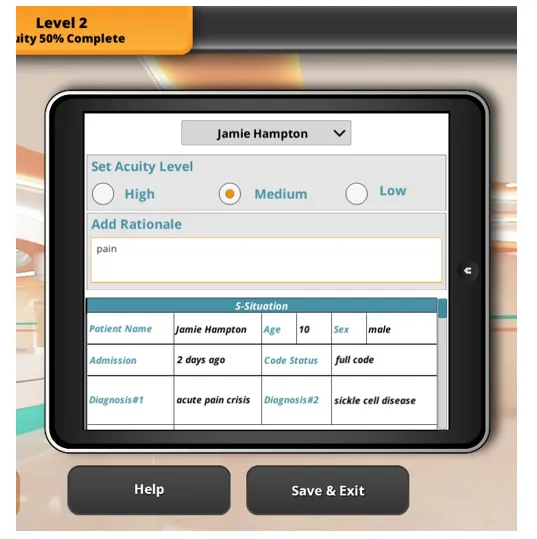
Sickle cell disease (SCD) is a genetic condition causing red blood cells to be in a sickle shape and affecting the mobility of the blood cells. This leads to complications that cause pain, organ damage, and loss of quality of life. It is an early childhood disease diagnosed early on, and the child should undergo specialist care to avoid complications in later life. Children with SCD need tailored care, as this allows children to have a better quality of life and reduces complications (Schieve et al., 2022). This assignment will elaborate on one of the journal articles on barriers and facilitators of holistic care in children with sickle cell disease, to treat a 10-year-old boy, Jamie Hampton, with SCD pain.
Abstract of the Research Article
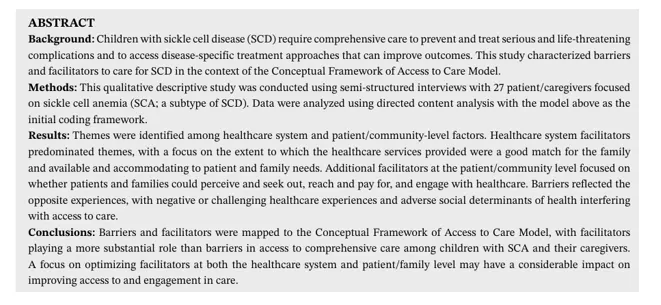
Our chosen article is Barriers and facilitators to paediatric sickle cell care: a qualitative descriptive study, Schlenz et al (2025), a qualitative descriptive study that provides the barriers and facilitators to holistic care of children with sickle cell disease. The authors analysed data from semi-structured interviews of 27 parents of sickle cell children. The Conceptual Framework of the Access to Care Model was used to do a directed content analysis. Such qualitative studies provide a detailed account of what it is like as a patient or a carer to go through an issue; they can be helpful in determining access barriers. Qualitative research isn’t as rigorous as quantitative research, but it does provide you with some knowledge of the problem, and you can learn from this to better care. The study provides Level VI evidence, which is especially helpful in patient experience and enhancing patient-centered care, albeit being lower on the hierarchy of evidence.
ArticleCredibility
It is a plausible article for a few reasons. First, because they have published their article in a peer-reviewed journal about the topic, Pediatric Blood & Cancer. First, since it is a study sponsored by NIH, and thus a measure of the quality of the study (Schlenz et al., 2025). Two, it has been endorsed by the Institutional Review Board (IRB). The authors of the study have published other studies on pediatrics or hematology. In addition, the research contains information on various locations, thereby rendering the study genuine.
Significant Results of the Research
This paper has brought out the fact that there were a number of factors that supported and hindered sickle cell care. This was by way of positive parent-provider relations, support, and education. This led to greater health care satisfaction and engagement (Schlenz et al., 2025). The support and support services (e.g., appointments, transport). There were problems, the study found. The lack of knowledge of health care providers, waiting times, and appointments was the issue in the health system. The individual issues were transportation, money, no-show (failure to attend), and employment/studying opportunities (Sang et al 2025). These may have an influence on health and health care. The most prevalent power outage in health care was in public transport.
Relevance to Sickle Cell Disease
The work is also relevant in coming up with innovative solutions to tackle sickle cell disease since sickle cell disease needs to be handled on a long-term and comprehensive basis. The disease symptoms and signs without effective treatment are pain, complications, and hospitalizations. The identified children with SCD have various quality of life (QoL) needs and complications, which necessitate a variety of health care services (Schlenz et al 2015). They underscored the health care barriers and facilitators to enhance the quality of life of SCD.
Application to Patient
The presented study can be used in the case of the crisis of sickle cell disease in a 10-year-old child of Jamie Hampton. Jamie has pain crises that require treatment. Jamie may face delays and difficulty coordinating and getting care. He might have problems getting to appointments. The experiment demonstrates ways to enhance care. These are communication, education, and coordination. He has nurses who are looking after him. They can make sure that he is free of pain, educate, and coordinate (Ge et al, 2023). Therefore, with education, removing barriers, and offering enablers, we can enhance the care and experience of Jamie.
Application to Practice
This study can provide us with an idea. This can assist in empowering health care providers, including nurses, so as to overcome the health barriers. That is, parents will be assisted in transportation and well-informed and supported in their healthcare journey. Health-care professionals can also be more humble and practice cultural humility to care for the patient by being reflective of the patient or family (Hernandez et al., 2021). Barriers and facilitators will ensure that the health-care system can offer the most efficient health and well-being to the child with sickle cell disease.
Conclusion
The article looks at the barriers and facilitators of health care for sickle cell diseases. This points to the significance of proper health care, effective communication between the family members of patients and health care professionals, and social health support. These data help to tell Jamie Hampton’s story of barriers to care – and the importance of patient-centred care. This will assist healthcare practitioners in recognising the barriers and facilitators to the healthcare of children with sickle cell disease.